Sarraceniaceae · Pitfall trap (trumpet pitcher)
Sarracenia rubra
Walter, 1788
Sarracénie Douce
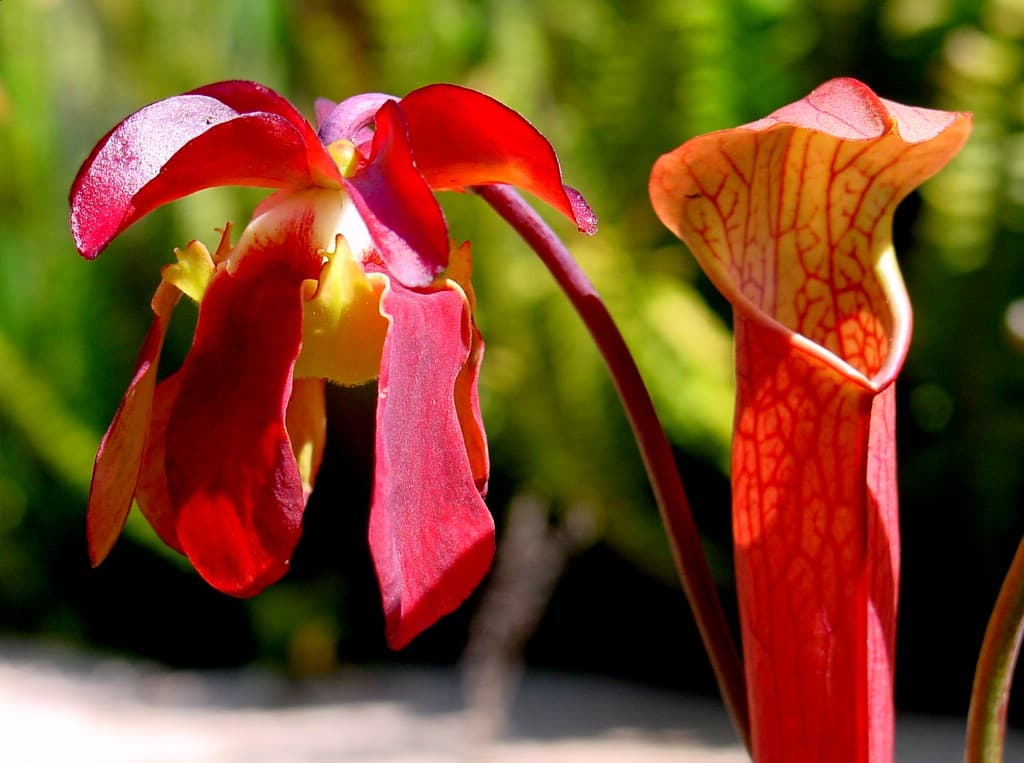
Description
Famille
Sarraceniaceae
Genre
SarraceniaAuteur
Walter
Décrite en
1788
Type de piège
Pitfall trap (trumpet pitcher)
Sous-espèces
5 subspecies: ssp. rubra, ssp. gulfensis, ssp. wherryi, ssp. jonesii (USA Endangered), ssp. alabamensis (USA Endangered)
Most taxonomically complex Sarracenia — 5 subspecies, two USA Federally Endangered. Narrowest pitcher in the genus. Mountain ssp. jonesii grows in Appalachian foothill seeps.
ssp. jonesii — Henderson/Transylvania/Polk counties NC; USA Endangered 1988. ssp. alabamensis — Chilton & Coosa cos. Alabama; also USA Endangered.
Entretien & Culture
6–8h/j
soleil direct
Arrosage par la méthode du bac (2–5 cm…
19 °C
min -5 °C
Tourbe de sphaigne
+2 types
3.5 – 5
très acide
Plage de températures recommandées en culture — valeurs jour (trait plein) et nuit (trait pointillé). Survoler le graphique pour les valeurs mensuelles.
Ensoleillement nécessaire
6h
minimum
8h
idéal
6h de soleil direct recommandées.
Floraison
>12h/j · Mars – Avril
Dormance nécessaire
Dormance hivernale obligatoire de novembre à février. Réduire l'arrosage, maintenir le substrat légèrement humide. Températures nocturnes proches de 0 °C tolérées et bénéfiques.
pH du sol / substrat
3.5 – 5
Très acide — tourbe, sphagnum ou substrats acides spécialisés.
Types de substrat (milieu naturel)
Mélange classique : 50 % tourbe de sphaigne blonde non fertilisée + 50 % sable de quartz lavé (0–2 mm). Sphagnum vivant en couverture de surface recommandé. Éviter tout substrat calcaire ou fertilisé.
Arrosage
Arrosage par la méthode du bac (2–5 cm d'eau en permanence dans la soucoupe pendant la saison de croissance). Utiliser uniquement de l'eau de pluie, osmosée ou déminéralisée. Réduire drastiquement en dormance : substrat légèrement humide mais pas gorgé d'eau.
Substrat de culture
50 % tourbe de sphaigne blonde + 50 % sable de quartz lavé. Rempoter tous les 2–3 ans au printemps. Bien tasser le substrat autour des rhizomes.
Luminosité
Plein soleil direct au moins 6 h/j en été. En intérieur, lampes horticoles LED spectre complet. Une luminosité insuffisante donne des pitchers allongés et pâles sans coloration.
Rempotage
Tous les 2–3 ans, en mars-avril juste avant la reprise de croissance. Nettoyer les vieilles feuilles mortes. Diviser les rhizomes si nécessaire.
Températures
Saison active : 20–35 °C le jour, 10–22 °C la nuit. Dormance : 0–10 °C (gel léger toléré pour ssp. purpurea). Ne pas chauffer en hiver.
Ravageurs & maladies
Cochenilles farineuses, pucerons, aleurodes. Traiter avec de l'huile de neem ou des insecticides systémiques doux. Les escargots peuvent détruire les pitchers : protéger mécaniquement.
Humidité
50–80 % en saison de croissance. La plupart des espèces tolèrent bien une humidité ambiante normale en extérieur. Éviter une humidité stagnante qui favorise les moisissures en dormance.
Fertilisation
Aucun engrais au substrat. Pulvériser occasionnellement (1×/mois) une solution très diluée d'engrais foliaire sur les pitchers (orchidée ½ dose) en saison active. Ne jamais fertiliser en dormance.
Conseils & astuces
Placer en terrasse ou jardin en plein air d'avril à octobre. Rentrer avant les premières gelées sévères pour les variétés sensibles. La dormance froide est indispensable à la floraison et à la vigueur à long terme.
Rusticité
Jusqu'à -5 °C
Dormance
4 mois / an
Exposition
Plein soleil direct
Floraison
Mars – Avril
Phylogénie
Habitat & Distribution
Loading map…
6 occurrences naturelles cartographiées
1North Carolina — Sandhills (ssp. rubra) · United StatesNorth America
Altitude
60–200m
Climat
Humid subtropical
Sol
Wet sandy bog
Coordonnées
35.000, -79.500
2Georgia — Tifton Upland savannas · United StatesNorth America
Altitude
50–150m
Coordonnées
31.500, -83.500
3Alabama — Talladega County (ssp. wherryi) · United StatesNorth America
Altitude
100–400m
Coordonnées
33.200, -86.100
4North Carolina — Henderson County mountain seeps (ssp. jonesii) · United StatesNorth America
Altitude
600–900m
Coordonnées
35.300, -82.400
5Alabama — Chilton County (ssp. alabamensis) · United StatesNorth America
Altitude
100–300m
Coordonnées
32.800, -86.600
6Florida Panhandle — Washington County (ssp. gulfensis) · United StatesNorth America
Altitude
0–50m
Coordonnées
30.600, -85.700
Conservation
Statut IUCN
VUMenaces
- Fire suppression
- Drainage
- Two critically endangered subspecies
Hybrides impliquant Sarracenia rubra
Sarracenia × gilpinii
Uncommon natural hybrid producing semi-recumbent pitchers with partial parrot-like hooding and red coloration from S. rubra. A curious combination of two southern species. Named in honour of Vincent Gilpin.
Sarracenia × rehderi
Natural hybrid between two small-statured species. Produces slender pitchers with partial hooding and red-flushed coloration. Relatively rare in the wild. Named in honour of Alfred Rehder.
Sarracenia rubra × leucophylla
Natural hybrid producing narrow pitchers with white reticulated tops flushed with red. Very attractive.
Sarracenia × ahlesii
Natural hybrid from the Gulf coastal plain where S. alata and S. rubra overlap. Produces pitchers of intermediate size with pale yellow-green to red-flushed coloration. Named in honour of William Ahles.
Sarracenia × chelsonii
Natural hybrid producing semi-erect to recumbent pitchers intermediate between the two parents. Red-purple coloration from S. rubra combined with the open, recumbent body of S. purpurea. Named in honour of Charles Chelson.
Sarracenia × popei
Intermediate hybrid between the tall yellow S. flava and the slender red S. rubra. Produces mid-height pitchers with yellow-green coloration flushed with red. Named in honour of John Pope.
Sarracenia × readii
Natural hybrid producing narrow pitchers with white reticulated tops flushed with red from S. rubra. Very attractive combination. Named in honour of John Read.
Communauté
Aucun cultivateur pour le moment
Sois le premier à cultiver Sarracenia rubra et à partager ton expérience !